Introduction
Choosing the right material for your gate pillars can make a big difference to the appearance, durability and cost of your entrance. From cast stone and natural stone to timber, concrete and metal, each option has its own advantages and drawbacks.
In this guide, we compare cast stone gate pillars with other popular materials to help you choose the best option for your property, budget and style.
What Are Cast Stone Gate Pillars?
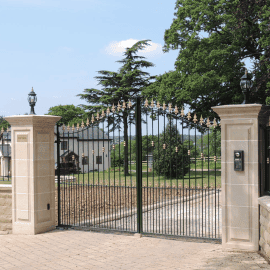
Cast stone gate pillars are decorative pillars made by casting a mix of natural aggregates and additives into moulds designed to replicate the look of stone. Once cured, they offer the appearance and texture of natural stone at a fraction of the cost and lead time.
Gate pillars and gate posts are not the same thing. Gate posts are functional, built purely to support a gate. Gate pillars go further. They are an architectural feature in their own right, framing an entrance and setting the tone for the whole property before a visitor even reaches the door.
Gate pillars are typically built up in sections: a base, a shaft and a pier cap, with the option to add a finial on top for extra detail. This modular approach makes them easier to manufacture, transport and install than a single block of natural stone of the same size.
For more information, see our Ultimate Guide to Cast Stone Gate Pillars.
Key Features
Sectional Construction
Gate pillars are manufactured in manageable sections rather than one solid piece, which makes handling and installation far more straightforward on site.
Pier Caps And Finials
Most pillars are topped with a pier cap, and many can be finished with a finial such as a ball, pineapple or acorn design for added character.
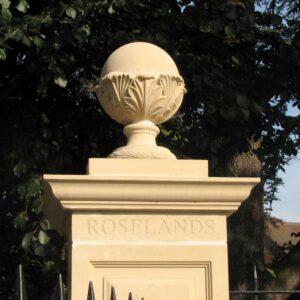
Getting the pier cap right takes more thought than it might seem. As Gavin, Project Manager at Acanthus Cast Stone, puts it, “We have to make sure that the overhang is correct; otherwise, we get water running down the front of the pillar itself.” Customers wanting to add a light on top will also need a flat-topped cap with a hole through the middle for the wiring to run through.
Bespoke Options
Beyond standard designs, pillars can be custom moulded to a specific height, width, profile or decorative detail.
Consistent Quality
As they are cast rather than carved, every pillar in a pair or set comes out to the same dimensions and finish, which is difficult to guarantee with natural stone.
Industry Standards
Reputable manufacturers produce pillars to BS1217 and the UKCSA specification for cast stone, giving buyers a recognised quality benchmark to look for.
Common Applications
Cast stone gate pillars manufactured in the UK are most commonly used at the entrances to residential driveways, where they frame a pair of gates and mark the property boundary. They are equally popular on:
- Period and heritage properties, where they help match new work to existing stone detailing
- New build homes looking to add the wow factor and a sense of establishment and permanence
- Care homes and gated developments, where a grand entrance supports the overall image of the site
- Boundary walls, where pillars are used alongside coping stones and pier caps to finish the wall at regular intervals
- Restoration projects, replacing pillars that have deteriorated or been damaged over time.
When a customer sends us an old photo showing what their pillars used to look like before they crumbled or were damaged, the first thing I do is get it over to our technical team. From there, one of the most satisfying parts of the job is seeing an entrance restored to what it originally looked like, rather than replaced with something that doesn’t belong.
What Are the Other Possible Types of Pillars?
Cast stone is not the only option for gate pillars. Depending on budget, style and the property itself, a few other materials are worth knowing about.
Natural Stone
Cut or quarried stone blocks give a genuinely timeless, premium look, and no two pillars are ever quite identical since each is worked from a natural block. This authenticity comes at a cost, though, both in price and lead time, since every piece has to be sourced and shaped by hand rather than produced to order.
Timber
Heavy-duty hardwood or composite posts pair naturally with wooden gates and panel fencing, giving a softer, more rustic look than stone or metal. They are usually the most affordable option, but timber needs more regular maintenance, such as treating or staining, to prevent rot and weathering, and it won’t offer the same permanence as a masonry pillar.
Concrete
Concrete masonry units, whether left plain or finished with a smooth or textured render, give a clean, low-maintenance surface at a lower cost than stone. The trade-off is that rendered finishes are more prone to cracking and discolouring over time, and they don’t carry the same wow factor nor the architectural detail that a cast or natural stone pillar can offer.
Metal
Hollow structural steel or weathered Corten steel posts suit a more industrial or contemporary property, offering a sleek, minimal look that stands apart from traditional masonry pillars. They are strong and low maintenance, though they read as a distinctly modern choice rather than one that complements a period or traditional façade.
Benefits of Cast Stone
Cost-Effective Compared to Natural Stone
Cast stone delivers a similar appearance to quarried stone at a lower cost, since it does not require the same labour-intensive cutting and carving.
Design Flexibility
As pillars are cast in moulds, intricate details such as fluting, mouldings and decorative pier caps can be reproduced accurately and repeatedly, something that is far more expensive to achieve by hand.
Consistency
Every unit cast from the same mould matches in size, profile and finish, which matters when you need pillars either side of a gate to look identical.
Durability
Well-made cast stone is dense, weather-resistant and built to withstand the UK climate for decades with only routine cleaning.
Faster Lead Times
Cast stone products can generally be manufactured and supplied more quickly than an equivalent piece cut from natural stone.
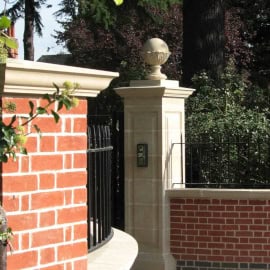
Adds Kerb Appeal and Value
A well-chosen set of gate pillars makes a strong first impression and is widely seen as a worthwhile investment in a property’s overall appearance and value.
Disadvantages of Cast Stone
Cracking if Installed Incorrectly
This is the most common issue with cast stone, and it almost always comes down to installation rather than the material itself. As Gavin explains, “all masonry, all materials, shrink and contract at different rates depending on what the weather’s doing,” and without slip planes or movement joints to let a building move as it settles and responds to temperature, that movement has nowhere to go but through the stone. The fix is straightforward, provided it is built in from the start: a flexible isolating membrane between stone and any concrete infill and slip planes or movement joints where the pillar meets surrounding masonry.
Weathering and Colour Change Over Time
Like natural stone, cast stone can show variation in colour as it weathers, particularly if it is shaded by trees or bushes. Gavin has seen this happen surprisingly quickly, describing stone that was “bright white” when installed and “black within 10 years, purely because trees and bushes are overhanging it.” The answer is a proper cleaning regime rather than reaching for a jet wash, which he warns is “likely to take the face of the stone off.” A manual approach, starting with a patio cleaner and moving to brick acid only if needed, is the safer route. For the full step-by-step process, see our complete guide to cleaning cast stone.
Upfront Cost versus Brick or Render
While cheaper than natural stone, cast stone gate pillars still cost more than a simple brick or rendered pillar, so budget is worth factoring in early.
Not Always Suitable for Listed Buildings
On some heritage or listed projects, planning authorities may specifically require natural or reclaimed stone, so it is worth checking local requirements before committing to cast stone.
How to Choose the Right Option
The right gate pillar material comes down to five practical factors: budget, architectural style, maintenance commitment, durability, and any planning restrictions on the property. Working through these in order narrows the options quickly, before landing on the specific pillar design.
Key Criteria
| What to Consider | Best Suited Materials | |
| Budget | Timber and rendered concrete cost the least; natural stone the most, due to quarrying and hand carving | Timber, concrete for lower budgets; cast stone for the best balance of cost and appearance |
| Architectural style | Period and heritage properties generally call for decorative, traditional detailing, while contemporary and luxury builds suit cleaner, minimal profiles. Cast stone works well for both, with plain, sleek pillar designs bringing the same quality and permanence to a modern entrance. | Cast or natural stone for traditional; plain, sleek cast stone for contemporary and luxury builds. |
| Maintenance commitment | Some materials need only occasional cleaning; others require regular treating, repainting or repair | Cast stone and natural stone for lowest upkeep; timber and render need more attention |
| Durability and lifespan | Masonry and metal are built to last decades; timber and render weather faster without upkeep | Cast stone, natural stone and metal for longevity |
| Planning restrictions | Listed buildings and conservation areas may specify natural or reclaimed stone | Always check with the local council before ordering |
| Climate and exposure | Rural properties with overhanging trees and coastal properties exposed to salt and wind both call for durable, low-maintenance materials | Cast stone or metal over timber or basic render |
Best Fit by Property Type
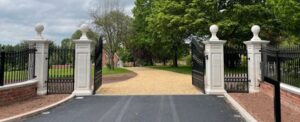
- Period and heritage homes: cast stone or natural stone, matched to existing brick or stonework.
- New build homes: cast stone, for an established, traditional look without the cost or lead time of natural stone, and for the wow factor it brings to a new development.
- Contemporary or architect-designed homes: plain, sleek cast stone pillars (see below), which suit contemporary and architect-designed homes just as well as period properties, with metal remaining an option for a more contemporary look.
- Rural properties: cast or natural stone, ahead of timber.
- Coastal properties: cast stone or metal.
- Commercial premises and gated developments: cast stone, often paired with matching pier caps and coping for a consistent entrance across multiple access points.
Pros and Cons Summary Table
| Material | Pros | Cons |
| Cast stone | Close match to natural stone appearance; consistent finish across pillars; wide range of decorative pier caps and finials; lower cost and shorter lead time than natural stone; frost-proof and long-lasting with routine cleaning | Can crack if installed without proper movement joints or a flexible membrane; costs more than brick, timber or basic render; quality varies between manufacturers |
| Natural stone | Authentic, timeless appearance; unique character in every piece; often required on listed or heritage buildings | Highest cost of all options; long lead times due to quarrying and hand carving; harder to achieve identical pillars as a pair |
| Timber | Lowest upfront cost; pairs naturally with wooden gates and panel fencing; softer, more rustic look | Needs regular treating or staining to prevent rot; shorter lifespan than masonry options; less architectural detail |
| Concrete / rendered block | Affordable; quick to build; clean, low-maintenance surface when new | Render prone to cracking and discolouring over time; limited decorative detail compared with cast or natural stone; little of the wow factor from cast stone |
| Metal (steel / Corten) | Strong and durable; low maintenance; distinctive, contemporary look | Suits modern or industrial properties only; doesn’t complement traditional or period façades; limited decorative options |
Overall Comparison
The right gate pillar material depends on budget, the style of the property, and how much maintenance you’re prepared to take on.
For most UK homes wanting a high-impact entrance, whether traditional or contemporary in style, cast stone offers the best overall balance. It closely matches the look of natural stone, holds its colour and detail for decades with only routine cleaning, and costs significantly less than quarried stone.
Our Cast Stone Gate Pillar Options
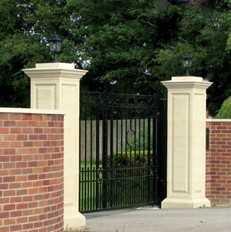
We produce a full range of standard cast stone gate pillar designs, from sleek block designs through to more ornate options. Our gate pillars are available in various sizes and can be varied in height, with matching pier caps, balls, finials and name or number stones also available:
Block Gate Pillars – a simple, sleek design that offers a versatile option for a range of entrances.
Doric Gate Pillars – a traditional design that adds architectural detail to your entrance.
Ionic Gate Pillars – a distinctive design that provides an elegant architectural feature.
Kensington Gate Pillars – a decorative design that can be complemented with a pineapple finial and base.
Quoin Gate Pillars – a more ornate option that creates an impressive entrance feature.
Tuscan Gate Pillars – a classic design that can be paired with a ball and base for additional detail.
View our Cast Stone Gate Pillars
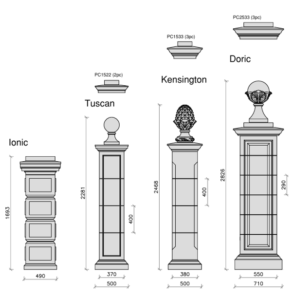
Alternatively, bespoke gate pillars can be manufactured to your dream design. Our team can create a custom mould tailored to your requirements, allowing you to create a unique design.
Our Colour Options
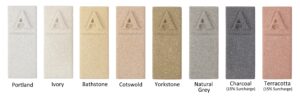
We offer a wide range of natural stone colour choices for your dream gate pillars to help you choose the right colour. We have created a blog to help you through the process.
To help you choose the right finish, we offer free samples so you can see and feel the material before ordering. This allows you to assess the texture, colour and appearance and ensure it complements your dream design.
Most of our cast stone colour options are available at no additional cost, with a 15% surcharge applying to Charcoal and Terracotta finishes.
Why Choose Acanthus
At Acanthus, we combine traditional craftsmanship with modern manufacturing techniques to create high-quality cast stone gate pillars for homes, commercial properties and restoration projects across the UK.
In my own conversations with customers, I see this play out again and again: some people start out wanting natural stone, but once I talk them through the price difference and they physically see and feel one of our free cast stone samples, it stops feeling like a compromise.
Our products are manufactured in Derbyshire in line with the performance requirements of BS 1217 Cast Stone, the UKCSA Specification for Cast Stone and NBS Clause F22, providing confidence in their quality and durability.
Frequently Asked Questions
| Frequently Asked Questions | Answer |
| What are cast stone gate pillars? | Cast stone gate pillars are decorative entrance pillars made from cast stone, cast into moulds to replicate the appearance of natural stone. They frame an entrance and provide a durable, attractive finish at a lower cost than natural stone. |
| What is the difference between a cast stone gate pillar and a gate post? | A gate post is a functional support for hanging a gate. A gate pillar does that job too but is also an architectural feature in its own right, framing the entrance and adding kerb appeal to the whole property. |
| How much do cast stone gate pillars cost? | Standard designs typically start from around £700 to £750 excluding VAT for simpler styles such as Block or Tuscan, rising to £2,000 or more for larger or more decorative options such as our Dordic design. Bespoke designs cost more due to the custom mould and additional design work involved. |
| What designs of cast stone gate pillars are available? | Acanthus offers a range of standard cast stone gate pillar designs, including Block, Doric, Ionic, Kensington, Quoin and Tuscan. Bespoke gate pillars can also be manufactured to suit specific requirements. |
| Can cast stone gate pillars be made to different sizes? | Yes. Cast stone gate pillars can be manufactured in different sizes and heights to suit the entrance, gate and proportions of a property. The size of the pillars can also affect the overall cost, as larger products require more material and production time. |
| Are bespoke cast stone gate pillars available? | Yes. Bespoke cast stone gate pillars can be manufactured to your requirements. A custom mould can be created to produce a unique design, although bespoke products may cost more due to the additional design and manufacturing work involved. |
Conclusion
So, which gate pillar material should you choose? For most homes, cast stone offers the best combination of appearance, durability, design flexibility and cost. Natural stone may be preferable where authenticity or planning requirements are the priority, while timber, concrete and metal can suit different budgets and architectural styles.
For further information on our cast stone products or to request a quote, feel free to contact one of our friendly Acanthus team or call us on 01773 540704.